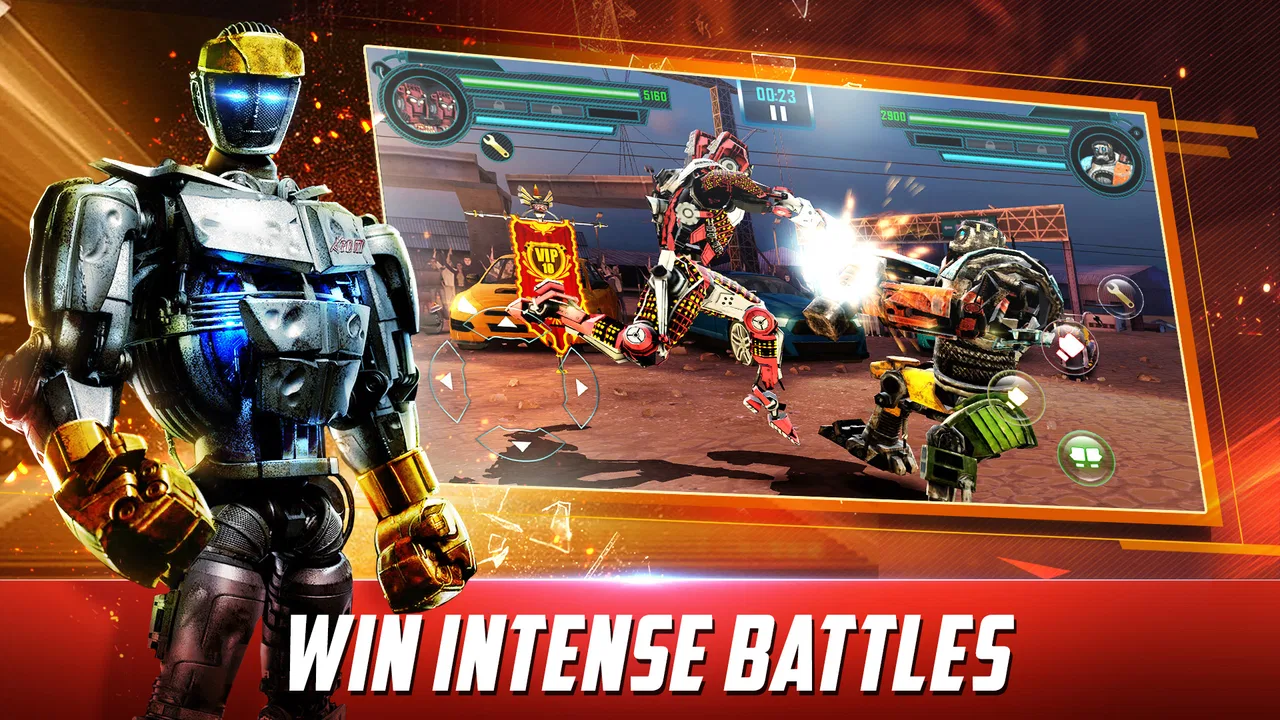
World Robot Boxing
- 4.5
- Rating
- 50.00M
- Installs
- Free
- Price

 Analysis by App-foxy
I did not expect a mobile boxing game built around giant machines to hold my attention for long, but World Robot Boxing has a surprisingly clear hook: it turns short fights into a test of timing, positioning, and upgrade choices. It is an action game from Reliance Games, and the basic idea is easy to understand within minutes. Pick a robot, enter the ring, read the opponent, and try to land enough well-timed attacks to take control of the match.
That simplicity is useful on a phone. I can play a quick bout while waiting, yet there is enough room for longer sessions when I feel like improving a robot or working through more difficult opponents. The game is free to download, carries a Teen content rating, and has reached more than 50 million installs. Its average score of 4.5 from roughly 2.3 million ratings suggests that the core experience has connected with a very large audience, although popularity alone does not remove the usual free-to-play compromises.
How the current version feels to play
The current version, 113.113.120, presents the game as a mature mobile action title rather than a small experimental release. The roster is built around more than 90 robots, which gives the collection side of the game real weight. I found that variety more important than I first expected: a new machine is not just a different skin when I am deciding how to approach a fight. Changing robots encourages me to adjust my rhythm, learn different attack patterns, and reconsider whether an aggressive or patient style suits the next opponent.
You May Also Like

 Blood Strike: 2.5 Anniversary
Blood Strike’s Loadouts Turn Every Drop Into a Tactical Gamble
A close look at Blood Strike’s custom loadouts: how fast access to signature weapons reshapes its battle royale rhythm, rewards preparation, and narrows the gap between fights.

 Pandora - Music & Podcasts
Pandora’s Music Is Easy to Start, but Harder to Recover
Pandora’s strength is its low-effort path from a seed to a station. Its weak spot is how much confidence it asks you to place in connection, setup, and quiet recovery.

 8 Ball Pool
 Is Built on Rivalries, Rematches, and Routine
A close look at the rivalries, rematches, shared routines, and unanswered safety questions that turn a quick pool match into a persistent mobile community.

 Samsung Music
’s Quiet Strength Is Playing What You Already Own
Its reach comes less from spectacle than from dependable access to a personal library. That simplicity is both the app’s strongest retention engine and its ceiling.

 AccuWeather: Weather Radar
AccuWeather Review: A Quick, Clear Forecast for Everyday Decisions
For everyday plans, the best forecast is the one you can understand quickly. AccuWeather makes rain timing, radar, and local conditions easy to act on, with a few trade-offs.

 Hill Climb Racing
Why Hill Climb Racing Still Turns Crashes Into One More Run
A tiny car, a bumpy hill and one more upgrade: Hill Climb Racing keeps resurfacing because its simple chaos makes every near-miss feel personal.
More From Our News Desk



The controls are designed for touch screens rather than trying to imitate a full console controller. That makes the first few fights approachable, but it also means precision depends on learning the game’s timing instead of simply tapping as quickly as possible. I get better results when I treat each exchange as a small decision: attack, defend, move, or wait for an opening. The most satisfying moments come from recognizing an opponent’s pattern and responding cleanly, not from filling the screen with random taps.
That distinction matters because the game can look like a button-mashing brawler at first glance. It is more enjoyable when I slow down enough to notice spacing and recovery. A strong opening does not guarantee a win if I spend all my momentum carelessly. Likewise, a defensive start can become an advantage when the other robot repeatedly commits to attacks that I can punish. This gives the fights a little more texture than the oversized robots and dramatic presentation initially suggest.
I would describe the overall pace as accessible rather than deeply technical. Someone who has never played a robot fighting game can understand the immediate goal, while experienced players can still chase cleaner victories and better decisions. It does not replace a dedicated fighting game with a large command system, but that is also why it works well on mobile. I can pick it up without remembering a complicated control layout.
A collection game disguised as a series of fights
The ring is only one part of the experience. The larger pull comes from building a group of machines and deciding where to spend attention. With such a broad roster, the temptation is to keep changing robots whenever a new option becomes available. I learned that spreading resources too thin can make progress feel slower, so I prefer choosing a small group and developing them with a purpose.
One practical approach is to keep a dependable main robot for difficult matches, then use other machines for experimentation. That gives me a stable fallback without removing the fun of trying something unfamiliar. It also makes losses more informative. If a new robot struggles, I can tell whether the issue is my timing, the matchup, or a lack of investment, instead of having every machine sit at roughly the same level.
This is one of the less obvious strengths of the game: the collection is most useful when treated as a set of play styles, not as a checklist. A player who only chases the newest or most impressive-looking machine may miss the value of learning one robot thoroughly. I get more satisfaction from understanding the strengths of a familiar machine than from constantly replacing it.
What the progression asks from the player
Progression gives the game a reason to return after a single match. Winning is not only about the result on the screen; it also contributes to the feeling that my chosen robot is becoming more capable. That structure is effective for short sessions because even a brief play period can feel connected to a longer goal.
The trade-off is that progression can make the game feel less purely skill-based. When a fight becomes difficult, I have to decide whether I need better execution or more development. That uncertainty is not always frustrating, but it can soften the satisfaction of a close victory. A player looking for a competitive experience where every outcome depends almost entirely on immediate ability may prefer a traditional fighting game with less emphasis on collection and improvement systems.
In everyday use, I find the best routine is to play a few matches, notice one recurring mistake, and stop before the session becomes repetitive. For example, if I keep losing after attacking too aggressively, I can use the next couple of bouts to practice waiting for a counter opportunity. This turns a quick mobile session into something more purposeful than endlessly replaying the same fight.
How the game has evolved for returning players
The release date, October 14, 2013, places this game among the long-running mobile action titles. Its current version shows that it has continued as an active product rather than remaining frozen in its original form. For a returning player, the most meaningful change is not simply seeing a familiar name again; it is finding a much broader robot-focused experience than a small launch roster could provide.
The large selection of machines also changes how new and existing players approach the game. A newcomer can spend time discovering a preferred style, while a returning player may find more reasons to revisit earlier choices and compare them with newer additions. I would not approach it expecting the exact same balance or pacing remembered from the early days. A long-running free game naturally feels more layered, and the current experience asks the player to engage with its wider progression structure.
That evolution is helpful for people who enjoy collecting and experimenting, but it may feel less focused to someone who only wants a quick arcade match. The game now works best when I accept both sides of its identity: it is an action fighter in the moment and a long-term robot collection between fights.
Where it fits beside other mobile action games
Compared with a conventional boxing game, this title has a much stronger fantasy element. The robots make the fights visually distinctive and allow the roster to feel more like a collection of machines than a lineup of athletes. Compared with a traditional fighting game, the controls are easier to approach, but the moment-to-moment combat is not aimed at players who want a deep competitive command system.
It also differs from a purely arcade brawler because the robot-building layer gives losses a longer context. I am not only asking whether I won the last match; I am also considering which machine deserves attention and whether my current approach will hold up later. That makes it a better choice for someone who enjoys gradual improvement than for someone who wants every session to be self-contained.
The clearest alternative is therefore not one specific rival but a different kind of experience. If I want quick spectacle, this game is a good fit. If I want a serious competitive fighter, a game built around more exact controls may be better. If I want a relaxed collection game with almost no pressure, the action and Teen rating may make this a poor match. Knowing that distinction before installing it prevents the common disappointment of expecting a completely different genre.
Small-session strategy that makes a difference
My most useful adjustment was to stop treating every opponent as a race to attack first. I watch the opening exchange, identify whether the enemy favors repeated pressure or waits for my mistake, and then choose a response. This costs a few seconds but usually gives me more information than immediate button pressing.
I also recommend testing a robot for several fights before deciding that it is weak. A machine can feel uncomfortable simply because its rhythm differs from the one I already know. Switching constantly makes every robot seem inconsistent. Staying with one long enough to understand its timing reveals whether the problem is the robot or my habits.
Another practical tip is to separate experimentation from progress. When I am trying to win a difficult sequence, I use the robot I know best. When I have time to learn, I test another machine without expecting an immediate perfect result. This simple division reduces frustration and helps the wide roster feel like an advantage rather than a source of indecision.
The best results come from combining careful timing with selective progression, not from tapping faster. That is the central lesson I would pass on to a friend. The game rewards attention, but it does not demand that every player study it like a professional fighting simulator.
Free access and the pressure to spend
The free entry point is important because it lets me understand the combat before deciding whether the longer progression is for me. However, the in-app purchase range runs from $0.99 to $299.99 per item, so spending can become a serious consideration for players who want to accelerate their progress or collect more rapidly. I would approach the game with a clear personal limit and avoid treating purchases as a solution to every difficult match.
For a younger player, the Teen rating and the presence of purchases are worth discussing with a parent or guardian before playing. The rating reflects the game’s action-oriented presentation, while the purchase system adds a separate practical concern. Free installation does not mean every part of the progression will feel equally free of pressure.
I prefer using the game as a skill-and-collection hobby rather than as a race. If I can accept that progress may take patience, the free version offers a reasonable way to explore the robots and decide whether the combat has lasting appeal. If I feel pushed to spend simply to keep up with my own expectations, that is a sign to step back rather than keep paying.
Who should play it, and who should skip it
I recommend it to players who like action games with a strong collection element, short repeatable matches, and a clear robot theme. It is especially suitable for someone who wants more interaction than an idle game but less complexity than a full traditional fighter. It can also work for a player who enjoys experimenting with different machines and gradually settling on a favorite.
I would be more cautious recommending it to someone with limited patience for upgrades, repeated matches, or purchase prompts. It is also not the right choice for a player seeking realistic boxing. The mechanical fighters are the point, and anyone looking for authentic athletes, simulation-style footwork, or a purely skill-based competitive environment should choose another category.
Storage, battery use, and the feel of the controls may also influence the decision, especially on an older phone. The minimum operating system is Android 7.1, so compatibility is broad on paper, but the smoothest personal experience will still depend on the device. I would install it on a phone with enough room for a substantial game and test a short session before committing to longer play periods.
What I would like to see next
Because the game has already grown into a large roster-driven experience, future improvements would be most valuable if they made that breadth easier to manage. Clearer guidance about which robot suits a particular play style would help new players make meaningful choices instead of selecting based only on appearance. Better explanation of progression decisions would also reduce the feeling that a difficult match can be solved only by investing more.
I would also like the game to keep protecting the importance of timing as the collection expands. More robots are useful when they create genuinely different decisions, not when they simply make the player chase a longer list. The strongest future direction would preserve the quick, readable fights while giving experienced players more reasons to refine a favorite machine rather than constantly replace it.
Those are expectations, not promises about a future update. What I can judge now is that the current version has enough history and content to serve both newcomers and returning players, provided they understand its hybrid design. It is not just a sequence of boxing matches, and it is not just a collector. The appeal comes from moving between the two.
My final recommendation
After spending time with it, I see World Robot Boxing as a dependable choice for mobile action fans who enjoy mechanical spectacle, repeatable fights, and gradual roster development. The combat is approachable, but it becomes more rewarding when I pay attention to timing and stop treating every bout as a frantic exchange. The large robot selection gives the game longevity, while the free price makes it easy to try without an immediate commitment.
Its limitations are equally clear. Progression can blur the line between player skill and robot development, the broad roster can encourage unfocused upgrading, and the purchase range means disciplined spending matters. Players wanting realistic boxing or a highly technical competitive fighter should look elsewhere.
For me, the deciding question is simple: do you want a quick action game that also gives you a reason to return and develop a machine? If yes, this is worth trying. I would begin with one dependable robot, learn its rhythm across several fights, and treat the rest of the roster as a gradual discovery rather than a demand to own everything. That approach brings out the game’s strongest qualities while keeping its free-to-play friction under control.
FAQs for World Robot Boxing
01What is World Robot Boxing?
World Robot Boxing is an action-packed mobile fighting game in which you control powerful robots in one-on-one boxing matches. Each machine has its own abilities, statistics, and visual design, while battles combine punches, special attacks, blocking, dodging, and tactical timing. The game focuses on upgrading your robot collection and competing through different arenas and game modes.
02Is World Robot Boxing free to download and play?
Yes, World Robot Boxing can generally be downloaded and played for free on supported Android and iOS devices. However, it includes optional in-app purchases that may help players obtain upgrades, resources, or new robots more quickly. Progress is still possible without spending money, although free players may need more patience when waiting for rewards, completing challenges, and improving their strongest machines.
03Does World Robot Boxing require an internet connection?
An internet connection is recommended for the best experience because several important features depend on online services. Multiplayer competitions, events, leaderboards, account synchronization, advertisements, and some rewards may not work correctly while offline. Certain parts of the game may remain accessible without a connection, but players should not expect every mode or progression feature to be available offline.
04How does robot upgrading work in World Robot Boxing?
Robot progression involves collecting machines, earning resources, and improving attributes that affect performance in the ring. Upgrades can increase offensive strength, defensive durability, health, or other combat-related capabilities, depending on the robot and available equipment. Choosing where to spend resources is important, since improving one favorite robot may be more effective than spreading limited materials across the entire collection.
05Is World Robot Boxing suitable for children?
World Robot Boxing is easy to understand, but parents should review the game’s age rating and store information before allowing younger children to play. Matches feature stylized robot combat, explosions, and repeated fighting, although the presentation is not realistic human violence. Because the game may contain advertising, online features, and optional purchases, parental controls and purchase restrictions are advisable.
Pros
- Fast
- satisfying robot battles with simple touch controls.
- Wide roster of customizable robots with distinct fighting styles.
- Multiple game modes provide variety beyond standard matches.
- Upgrade system gives battles a clear sense of progression.
- Stylish arenas and special effects make fights visually exciting.
Cons
- Progress can feel slow without frequent upgrades or grinding.
- Some powerful robots and items may require in-app purchases.
- Matches can become repetitive after extended play sessions.
- Online performance may suffer from lag on weaker connections.
- The game can consume considerable battery during longer sessions.

World Robot Boxing
Gallery